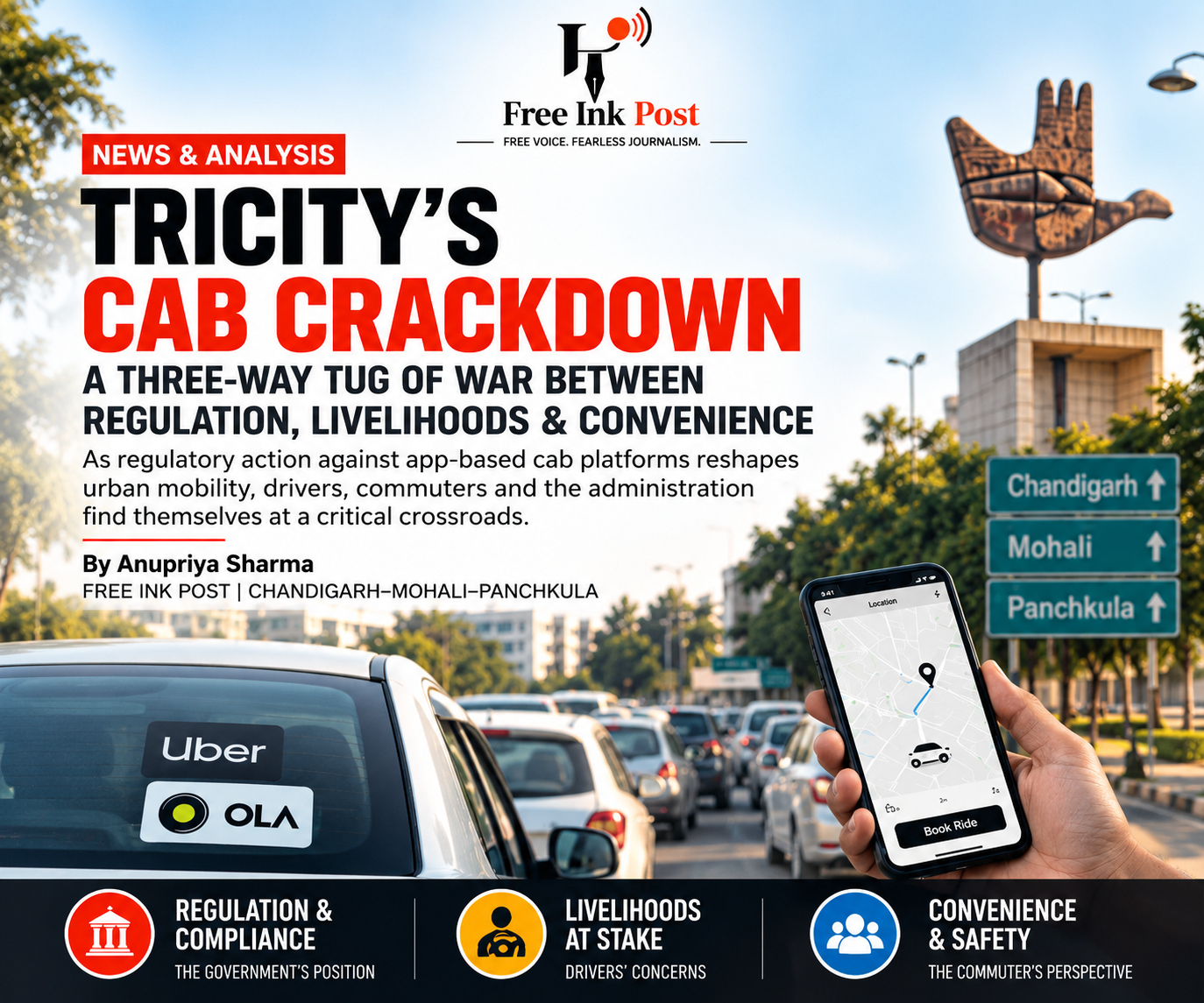
Tricity’s Cab Crackdown: A Three-Way Tug of War Between Regulation, Livelihoods & Convenience
As regulatory action against app-based cab platforms reshapes urban mobility, drivers, commuters and the administration find themselves at a critical crossroads.
BY ANUPRIYA SHARMA
FREE INK POST | CHANDIGARH–MOHALI–PANCHKULA
THE BIG PICTURE
The ubiquitous sight of a cab arriving at the tap of a smartphone has become an integral part of everyday life across Chandigarh, Mohali and Panchkula.
Now, that convenience faces a significant disruption.
The regulatory action against major app-based mobility platforms has triggered a wider debate—one that extends far beyond the fate of individual companies.
How can a rapidly evolving mobility ecosystem be regulated without compromising livelihoods, passenger convenience or public interest?
The unfolding situation brings three stakeholders into sharp focus: the government seeking regulatory compliance, drivers safeguarding their livelihoods, and commuters demanding safe, seamless and affordable mobility.
01 | THE GOVERNMENT’S POSITION
REGULATION CANNOT BE OPTIONAL
For the Chandigarh Administration, the issue centres on regulatory compliance, accountability and passenger protection.
Authorities have taken action against aggregators over alleged violations of the Chandigarh Motor Vehicles Aggregators Rules, 2025, with concerns reportedly encompassing fare structures, insurance, driver training, vehicle eligibility and other prescribed requirements.
The government’s position is straightforward: a technology platform facilitating public transportation cannot operate outside the legal framework governing that transportation.
Yet enforcement presents a delicate balancing act.
A regulatory intervention may address non-compliance, but its repercussions can reverberate across the entire mobility ecosystem.
02 | BEHIND THE WHEEL
DRIVERS AT THE CENTRE OF THE DISPUTE
For thousands of cab drivers, aggregator platforms represent far more than a digital interface.
They are a gateway to customers, a source of income and, for many, the foundation of their livelihood.
Drivers have raised concerns regarding fare structures, platform commissions, insurance, working conditions and the sustainability of their earnings after accounting for fuel, vehicle maintenance, financing and other operational expenses.
03 | THE COMMUTER’S PERSPECTIVE
WHEN CONVENIENCE MEETS UNCERTAINTY
For passengers, app-based mobility has fundamentally transformed urban transportation.
A few taps can provide a vehicle, an estimated fare, driver information and digital payment.
But when availability becomes uncertain, a routine commute can quickly become a logistical challenge.
A fare that appears reasonable to a passenger may not necessarily translate into a viable income for the person behind the wheel.
THE DRIVER’S QUESTION
Where does the next booking—and consequently the next day’s income—come from?
PASSENGERS EXPECT
• Transparent and predictable fares
• Verified drivers and compliant vehicles
• Passenger safety
• Reliable availability
• Digital convenience
• Effective grievance redressal
Mobility should be safe. Dependable. Transparent. Accessible.
THE BIGGER QUESTION
WHO BEARS THE BURDEN?
The most consequential aspect of the controversy lies in its ripple effects.
When an aggregator faces regulatory action, the consequences do not necessarily stop at the corporate level.
Drivers can lose access to customers. Commuters can lose access to familiar transportation. The administration faces the challenge of enforcing rules without creating a mobility vacuum.
Three stakeholders. Three legitimate concerns. One complicated ecosystem.
TOWARDS A SUSTAINABLE MOBILITY FRAMEWORK
FAIRNESS FOR DRIVERS
Transparent commissions, rational fare structures, insurance protection and accessible grievance mechanisms.
SAFETY FOR PASSENGERS
Stringent driver verification, compliant vehicles, emergency assistance and clear accountability.
ACCOUNTABILITY FOR AGGREGATORS
Technology companies facilitating transportation must shoulder clearly defined legal and operational responsibilities.
RELIABLE ALTERNATIVES
Alternative mobility platforms must offer adequate fleet availability, competitive pricing, technological reliability and consumer confidence.
NOT MERELY A BAN.
A TEST OF GOVERNANCE.
The Tricity’s cab controversy is ultimately larger than any individual platform.
It is a test of how a modern urban transport ecosystem reconciles regulation with innovation, corporate responsibility with economic livelihood, and convenience with public safety.
For the administration, the challenge is to enforce the law without creating a mobility vacuum.
For aggregators, it is an opportunity to demonstrate that technological disruption must be accompanied by institutional accountability.
For drivers, the pressing concern is that regulatory reform should not translate into economic vulnerability.
And for commuters, the expectation remains remarkably simple:
A CAB SHOULD BE SAFE.
A FARE SHOULD BE TRANSPARENT.
A SERVICE SHOULD BE RELIABLE.
AND A LIVELIHOOD SHOULD BE RESPECTED.