
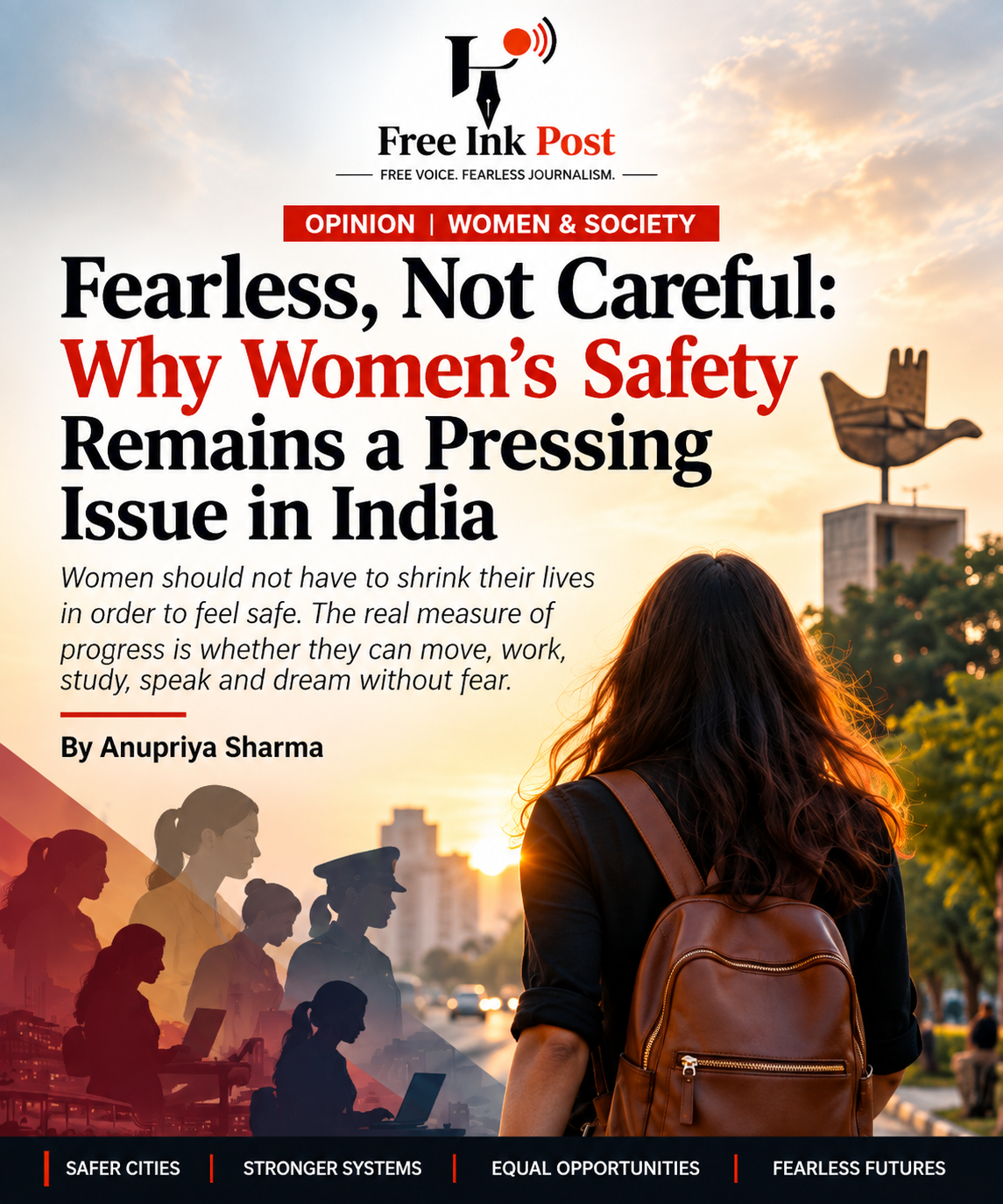
Fearless, Not Careful: Why Women’s Safety Remains a Pressing Issue in India
Women should not have to shrink their lives in order to feel safe. The real measure of progress is whether they can move, work, study, speak and dream without fear.
By Anupriya Sharma
Women’s safety can no longer be discussed as though it begins and ends at the front door or on a deserted street. The question now extends across public transport, workplaces, educational institutions, homes and digital platforms. As women’s lives have expanded into new professional, social and technological spaces, the risks they encounter have also changed. The response must evolve with them.
A woman should be able to leave home without mentally rehearsing a safety plan. She should be able to travel alone, return from work after sunset, use public transport, accept a late shift, study in another city and pursue an opportunity without first calculating the danger attached to it. Yet for many women in India, ordinary freedom is still accompanied by an extraordinary question: “Will I be safe?”
The Numbers Demand Attention
The latest official Crime in India 2023 datasets published by the National Crime Records Bureau (NCRB) through the Government of India’s Open Government Data platform document crimes against women across multiple categories and States and Union Territories. The scale of registered crime is a reminder that women’s safety is not a marginal social concern; it is a continuing public-safety and institutional challenge.
Even official crime figures must be read with care. Registered cases tell us what entered the criminal-justice system; they do not necessarily represent every incident that occurred. Fear of retaliation, social stigma, economic dependence, family pressure and uncertainty about the reporting process can all influence whether a woman approaches the authorities. Behind every case number is a person whose sense of security, dignity and freedom may have been altered.
Punjab’s Response: From Helplines to Coordinated Support
Punjab’s Project Hifazat, launched in March 2025, reflects an important shift in how women’s and children’s safety is being approached. The initiative is designed to strengthen the response to violence through a 24×7 Women and Child Helpline 181 and closer coordination among government departments and agencies. Emergency and non-emergency assistance, referrals and support mechanisms are intended to make the system easier to reach when a woman or child is in distress.
The significance of such a model lies in recognising that safety is not solely a policing issue. A survivor may need immediate protection, but she may also require medical care, legal assistance, counselling, shelter, rehabilitation or sustained institutional support. A responsive system must therefore connect these services rather than leaving individuals to navigate them alone.
But the larger test is prevention. A society cannot consider itself safe merely because it has become better at responding after harm has occurred. The deeper objective must be to reduce the conditions in which violence, harassment and intimidation are allowed to flourish.
Safety Does Not End at the Street Corner
Public discussion often imagines women’s safety in terms of dark roads, isolated places or unsafe transport. These concerns are real, but they are only part of the picture. Violence and harassment can occur in homes, offices, colleges, factories, institutions and online spaces—sometimes at the hands of people the victim already knows.
Digital life has created an additional frontier. Cyberstalking, impersonation, non-consensual sharing of personal material, online threats, persistent harassment and misuse of personal information can reach a woman anywhere, including inside her home. The distinction between “online” and “offline” safety is therefore becoming increasingly artificial. Digital security must now be treated as an integral part of women’s safety.
Stop Making Women Responsible for Preventing Violence
For generations, women have been given an exhausting catalogue of instructions: do not travel alone, do not stay out late, share your location, watch what you wear, avoid certain routes and remain constantly alert. Some practical precautions may be useful in particular circumstances, but they cannot become society’s principal answer to violence.
The burden of preventing violence cannot rest primarily on the person at risk of becoming its victim.
Responsibility must also lie with those who create unsafe environments and with the institutions expected to prevent and address misconduct. Schools should teach consent, boundaries, equality and respect early. Workplaces must maintain credible and accessible mechanisms for reporting harassment. Police and public authorities must handle complaints professionally, sensitively and without prejudice. Technology platforms must respond effectively to abuse and misuse.
Equally important is the language society uses when a woman reports harm. Questions about where she was, what she wore, why she was alone or why she did not report sooner can quietly move scrutiny away from the alleged offender and onto the complainant. Accountability should focus on the conduct in question; support should focus on the person seeking help.
Safer Cities Need Stronger Systems
The physical design and management of cities matter. Reliable public transport, adequate street lighting, functioning emergency communication systems, thoughtfully deployed CCTV, safer last-mile connectivity and visible policing can reduce vulnerability and improve confidence in public spaces. Yet infrastructure, by itself, is not enough.
Women must also have reason to believe that when they ask for help, someone will respond—and respond well. That requires emergency systems that work, helplines that are answered, investigations that are competent, complaints that are treated seriously and survivors who can access legal, medical and psychological support without being forced through a maze of institutions.
A safety system should not be judged by the number of mechanisms it announces, but by how reliably those mechanisms function when someone needs them.
From Fear to Freedom
The debate over women’s safety cannot be reduced to crime tables, helpline numbers or policy announcements. Those tools matter, but the real measure of progress is whether women experience greater freedom in everyday life.
A woman should not have to reject a job because the shift ends late. She should not have to abandon public transport because the journey feels unsafe. She should not have to surrender an educational opportunity because it requires living away from home, or turn down an assignment because travelling alone seems too risky. Safety should enlarge a woman’s choices—not dictate their limits.
India has laws, institutions, helplines and state-level initiatives intended to improve women’s safety. Their effectiveness depends on implementation, accountability and public trust. Lasting change, however, also requires something more difficult to legislate: a transformation in social attitudes towards consent, equality, dignity and responsibility.
The goal should not be to teach women how to live cautiously. It should be to build a society in which they can live confidently.
A truly progressive society is one in which women can walk, work, study, travel, speak and dream without fear. Women deserve more than repeated advice to “be careful”. They deserve institutions, communities and public spaces that are careful about their safety.
Source note
Official references: National Crime Records Bureau, Crime in India 2023 datasets published on the Government of India Open Government Data platform; and Government/Akashvani reporting on Punjab’s Project Hifazat (March 2025).